Showing posts with label Scottish painter. Show all posts

Sunday, March 16, 2014

Sir Daniel McNee

Sir Daniel McNee (1806-1882) was a Scottish painter who mostly did portraits. He was said to have "inimitable powers as a teller of humorous Scottish anecdotes."

 John Ramsay McCulloch
  
 Professor Allen Thomson (1878)
 [he was a physician, known as an anatomist and embryologist]
  
 A Lady in Grey (1859)
  
Portrait of a Young Boy
[a young boy...?]

Thursday, February 27, 2014

William Ewart Lockhart

William Ewart Lockhart (1846-1900) was a Scottish painter.

 Alnaschar's Fortune, Arabian Nights (1879)
  
 Cardinal of Rheims (1876)
  
 Queen Victoria's Golden Jubilee Service, Westminster Abbey, 21 June 1887
  
 Spanish Village
  
The White Cockade (1899)

Tuesday, February 18, 2014

John Robertson Reid

John Robertson Reid (1851-1926) was a Scottish painter who worked mainly in Surrey and Cornwall. His sisters were also painters.

 A Country Cricket Match (1878)
  
 A Friend in Need
  
 Gypsies at the Bell Inn
  
 Springtime (1898)
  
The Pleasures of Childhood

Thursday, February 13, 2014

William Marshall Brown

Born in Edinburgh, William Marshall Brown (1863-1936) studied at the city's Royal Institute. He also spent time in London and painted in the Netherlands and France, but became recognized for his figurative work in Scottish landscape settings. Although he ranged across Scotland, he, like the 'Glasgow Boys,' found Cockburnspath a useful base and kept a studio there from which he executed some of his best work. [John Gray Centre]

 At the Water's Edge
  
 Hoeing the Fields (Pitting Potatoes) (ca. 1911)
  
 Collecting Shells
  
Fishing Girls (ca. 1900)
studied at the city’s Royal Institute and the RSA’s Life School. He also spent time in London and painted in the Netherlands and France but became recognised for his figurative work in Scottish landscape settings. Although he ranged widely across Scotland he, like the ‘Glasgow Boys’, found Cockburnspath a useful base and kept a studio there from which he executed some of his best work. Many of his works are large, exhibiting broad and rapid brushwork and a bright palette. A favourite composition might be executed several times with slight variations. - See more at: http://www.johngraycentre.org/people/artists/william-marshall-brown-rsa-1863-1936/#sthash.Xet0xYtm.dpuf

Saturday, February 8, 2014

William Leighton Leitch

William Leighton Leitch (1804-1883) was a master Scottish landscape watercolor painter and illustrator. He was Drawing Master to Queen Victoria for 22 years. He was Vice President of the Royal Institute of Painters in Watercolours, on Pall Mall in London, for twenty years.

 Figures before Roslin Chapel, near Edinburgh (1875)
  
 Harbour Scene at Salerno, Italy (1872)
  
 Hayward's Heath
  
 Mediterranean Coastal Scene
  
 Aberystwith

Friday, January 31, 2014

James Paterson

 Castlefern (1880-85)
  
 The Last Turning, Winter, Moniaive (1885)
  
 A Village in East Linton, Haddington
  
Thornhill (1893)

Friday, December 20, 2013

George W. Simson

George W. Simson (1791-1862) was a Scottish painter of portraits and genre scenes.

 A Coronach in the Backwoods 1859)
[a coronach is a funeral song]
  
 The Girl at the Well (Peasant Girl) (ca. 1831)
  
The Village Ford

Friday, December 13, 2013

Sir David Wilkie

Sir David Wilkie (1785-1841) was a prominent Scottish painter. He was one of the artists featured in this blog's very first post.

 Chelsea Pensioners Receiving the Gazette Announcing the Battle of Waterloo (ca. 1819)
  
 Distraining for Rent 1815)
["distrain" means "to seize someone's property to obtain payment
of rent or other money owed" (I had to look it up!)]
   
 His Highness Muhemed Ali, Pacha of Egypt (1841)
  
 Josephine and the Fortune Teller (1837)
[a depiction of the famous episode where Josephine is told of her destiny to be Empress]
  
 Newsmongers (1821)
  
 Pitlessie Fair (1804)
  
 Reading the Will (1820)
  
 Self-Portrait 1805)
  
 The Blind Fiddler (1806)
  
 The Defense of Saragossa (1828)
[depicts the Spanish efforts to resist the second siege of Saragossa in Spain by the 
troops of Napoleon. It highlights Agustina de Aragon, the Maid of Saragossa, 
who took a place at the guns during the three month siege in 1808]
  
 The First Earring (1835)
  
 The Letter of Introduction (1813)
[a very well portrayed little drama]
  
 The Pedlar (1814)
  
 The Penny Wedding (1818)
[nowadays they run about $10K (if you're frugal)]
  
The Refusal (1814)
[Wilkie took his subject from the Robert Burns song 'Duncan Gray', (1798)
in which proud Maggie initially refuses Duncan's proposal of marriage,
but later changes her mind. Wilkie's friend, the painter William Mulready,
was the model for Duncan.]

Tuesday, December 3, 2013

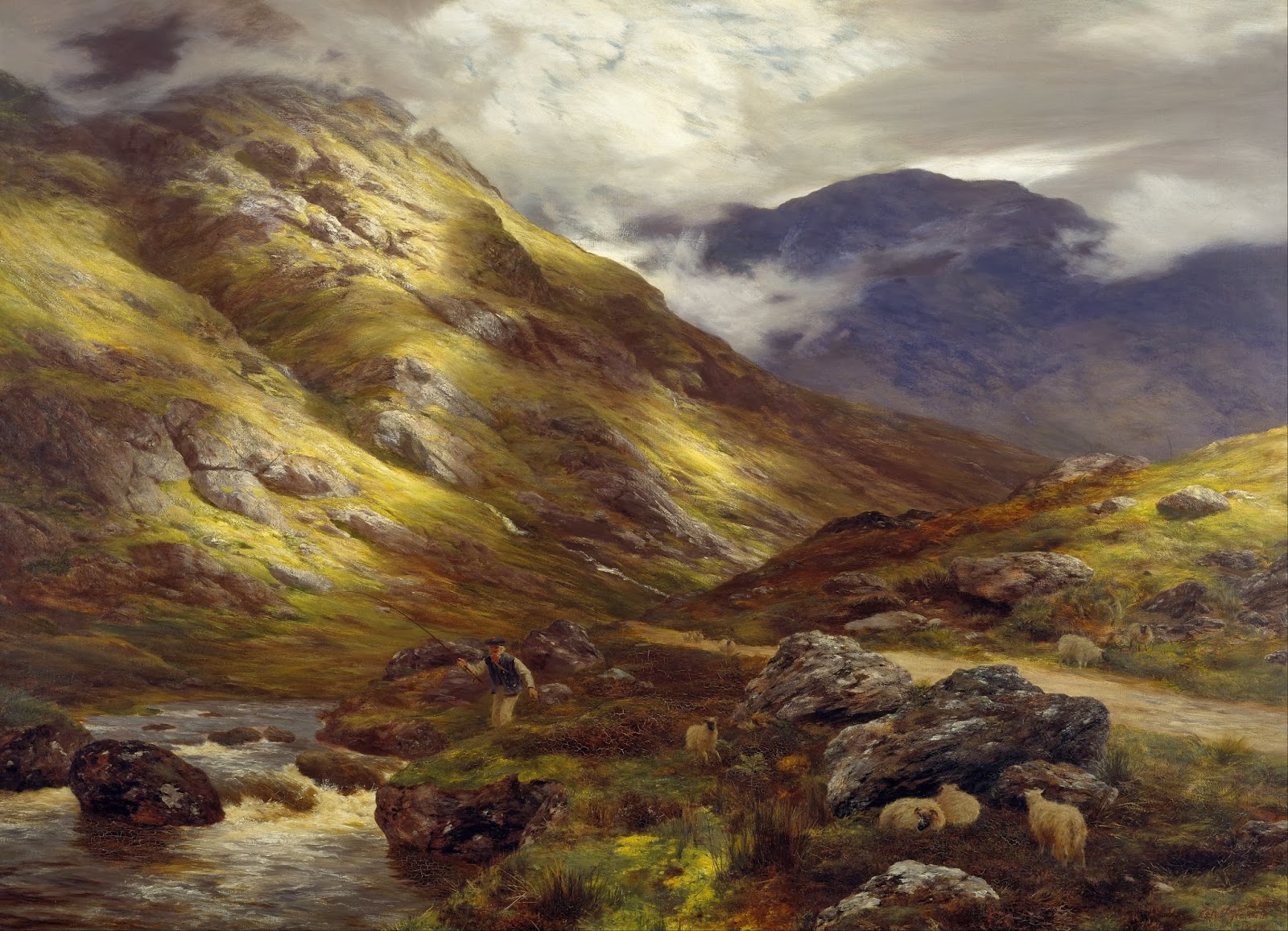
Peter Graham

Peter Graham (1836-1921) was a Scottish landscape artist. At least given the examples here, he seems to have been drawn to bleak landscapes.

 After the Massacre of Glencoe (1889)
  
 Highland Cattle in a Mountainous Landscape (1900)
  
 The Grass Crown Headland of a Rocky Shore
  
Wandering Shadows (1878)

Friday, September 13, 2013

Waller Hugh Paton

Waller Hugh Paton (1828-1895) was a Scottish landscape artist.

 'Mang the Braes of Balquhidder (1860)
  
 Castletown of Braemar
  
 Craigmillar Castle (1861)
 
 Entrance to the Cuiraing, Skye (1873)
  
 In the Devon Valley near Dollar - After Rain (1874)
  
 Loch Achray, the Pleased Lake (1859)
  
 On the Cree at Newton Stewart
  
On the Wooden Jetty