Tuesday, July 23, 2013

An Effusion of Edwards

 Edward Armitage: Retribution (1858)
[This appears to be an allegorical painting representing Britannia's vengeance
on India, represented by the tiger, following the Sepoy Rebellion of 1857.
Below is a cartoon from 1857 on the same theme.]
  
  
Edward Armitage: The Siren (1888)
 
Edward Charles Williams: The Moonlit Ferry Crossing
 
Edward Ladell: Still Life of Grapes, Raspberries and Peaches
 
Edward Masters: A Surrey Village
 
Edward Masters: Village Scene with figures before a stable
 
Edward Matthew Ward: Leicester and Amy Robsart at Cumnor Hall (1866)
 
Edward Partridge: Country Life (1874)
 
Edward Pritchett: View of St. Mark's Square and Doges Palace 
from Santa Maria Della Salute, Venice
 
Edward Robert Hughes: Dream Idyll (A Valkyrie)
 
Edward Robert Hughes: On the Wings of the Morning

Monday, July 22, 2013

Robert Thorne Waite

Robert Thorne Waite (1842-1935) was a landscape artist who often worked in watercolor.

 Harvest Landscape
 
 Harvesters Near Amberley
 
On the South Downs above Chichester

Sunday, July 21, 2013

Thomas Edwin Mostyn

Thomas Edwin Mostyn (1864-1930), the son of the artist Edwin Mostyn, studied at the Manchester Academy of Fine Arts. He had his first local exhibition in 1880, and was showing at the Royal Academy by the age of 29.  He is mainly recognized for his romantic garden scenes, although his style was so eclectic throughout his career that it is hard to believe that the same artist created all of his paintings. Many of his earliest works were strongly influenced by the strong anti-"Victorian Materialist" sentiment of his teacher Sir Hubert Von Herkomer (whose school he entered in 1893).  In these works Mostyn depicted the poverty of the working classes in the style of the realists, an effective way of raising social consciousness. [this summary is an excerpt from Rehs Gallery]

 A Fisherman's Daughter
 
 Gather Ye Rosebuds While Ye May
 
 Jewels
 
King Henry VII Fining the Citizens of Bristol 
Because Their Wives Were So Finely Dressed, 1490
 
 The Child
 
The Jeweled Box (1900)

Saturday, July 20, 2013

Dog Paintings

The Victorians loved their dogs, and there were a number of artists who specialized in painting them. Here is some of their work.

Arthur Alfred Davis: Working Field Spaniels (ca. 1880)
 
Arthur Wardle: After the Ball
 
Arthur Wardle: Champion Greyhound Dee Flint
 
Arthur Wardle: My Lady's Companion (ca. 1900)
 
Arthur Wardle: No One Home
 
Arthur Wardle: No Trespassing
 
Arthur Wardle: Rabbiting
 
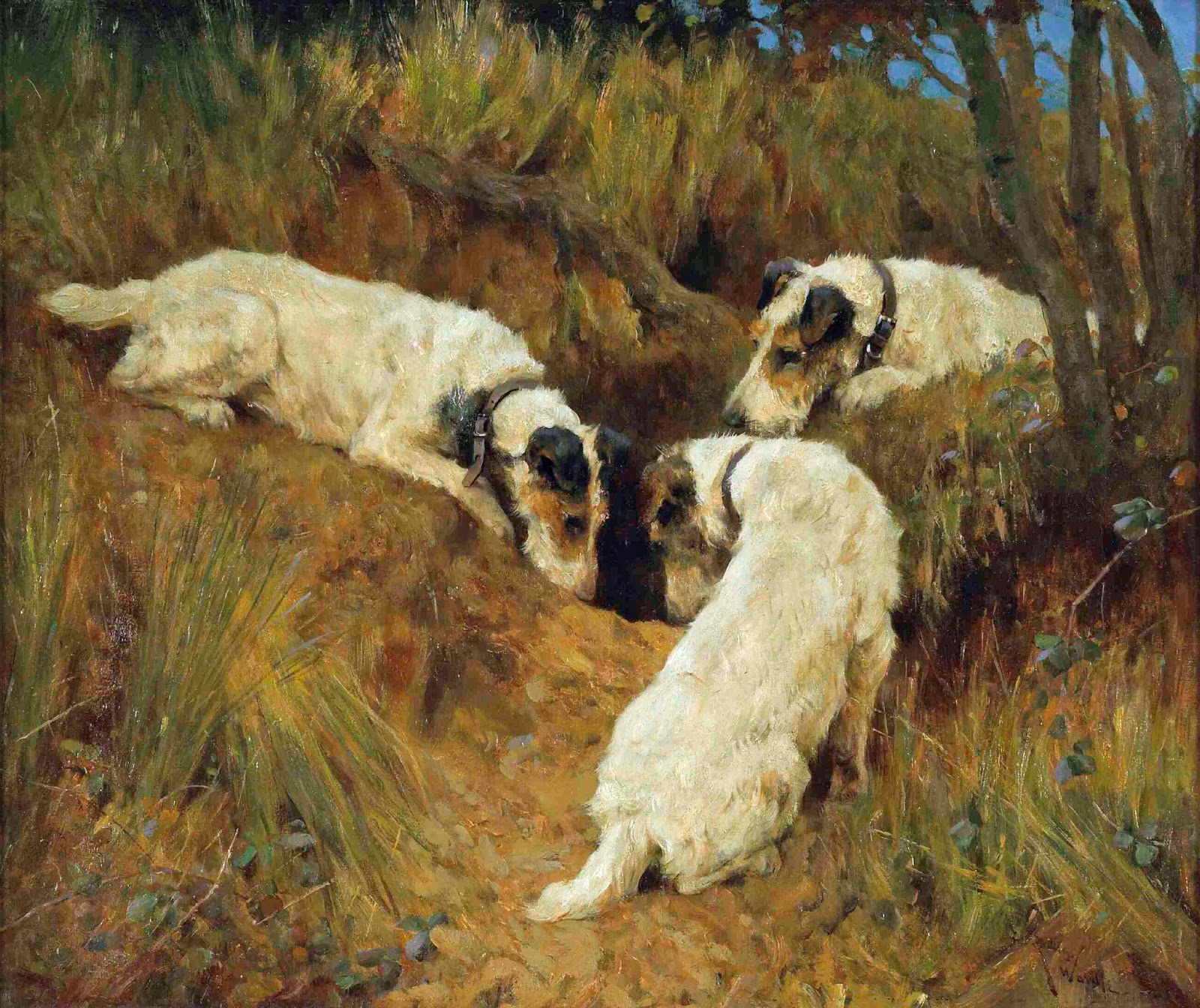
Arthur Wardle: Terriers on the Scent
 
Arthur Wardle: Three Terriers on the Scent
 
Arthur Wardle: Two English Setters on a Grouse Moor (1903)
 
Arthur Wardle: Waiting for Master (1885)
 
John Emms: Beagles - Fathers of the Pack
 
John Emms: Char
 
John Emms: Foxhounds and a Terrier
 
John Emms: Foxhounds and Terrier in a Stable Interior (1878)
 
John Emms: St. Bernards - To the Rescue
 
John Emms: Zoe (1896)
 
Maud Earl: Champion Old Hall Beatrice (1888)
 
Maud Earl: Field Spaniel (ca. 1890)
 
Maud Earl: Portrait of a Great Dane
 
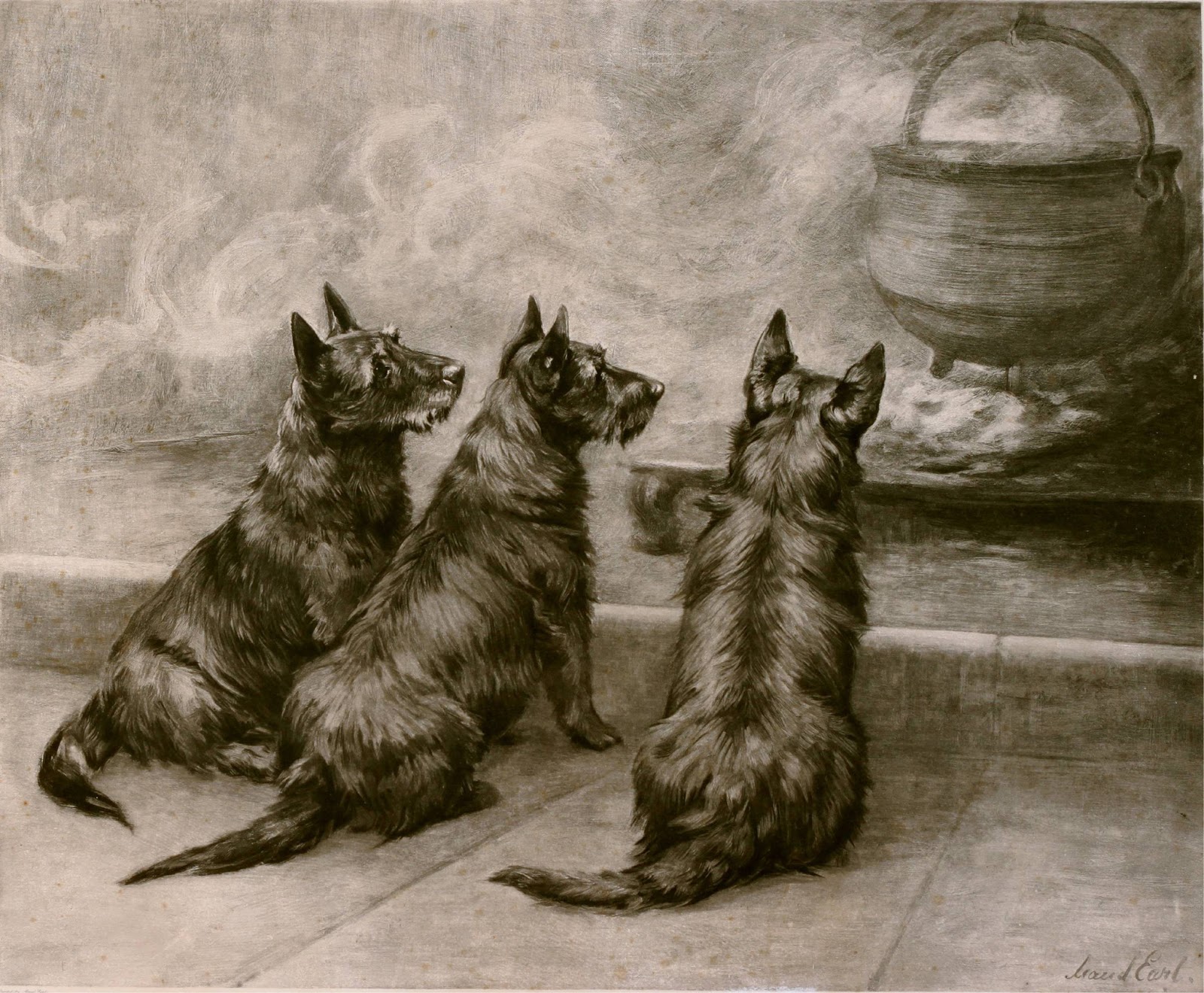
Maud Earl: The Pot Boilers
 
William Henry Hunt: Yorkshire Terriers 'Alexander & Diogenes' (ca. 1850)

Friday, July 19, 2013

Elizabeth Thompson, Lady Butler

Elizabeth Thompson, Lady Butler (1846-1933) was a British painter, one of the few female painters to achieve fame for history paintings, especially military battle scenes, at the end of that tradition. She was married to Lieutenant General Sir William Butler, and is still often referred to as Lady Butler. Some of her most famous military scenes come from the Napoleonic Wars, but she covered most major 19th century wars and painted several works showing the First World War. She wrote about her military paintings in an autobiography published in 1922: "I never painted for the glory of war, but to portray its pathos and heroism."

Here is a biography of Lady Butler.

 Balaclava (1876)
[a major battle in the Crimean War]
 
 Return from Inkerman (1877)
 
 Scotland Forever (1881)
 
 The 28th Regiment at Quatre Bras (1875)
[this engagement occurred during the Waterloo campaign]
  
 The Remnants of an Army (1879)
 
 Evicted (1880)

Thursday, July 18, 2013

Sigismund Christian Hubert Goetze

Sigismund Christian Hubert Goetze (1866-1939). Despite the name, this painter was British-born. He entered the Royal Academy Schools in 1885. From 1888 he exhibited regularly at the Royal Academy and at the Paris Salon. Goetze established a successful practice as a portrait and figure painter, later turning to landscape work. 


 The Ever Open Door (1906)
 
 Thy Voice is like to Music heard ere Birth/Some Spirit-Lute touched on a Spirit Sea (1902)
 
 Til Death Do Us Part (1910)
 
 Venus Visits Vulcan (1909)
 
 Vox Humana...Hear, Nature, Hear! (1903)
 
Zouaves. Portrait of Francis and Philip Mond, sons of Emile Mond (1904)