Monday, March 24, 2014

W is for William

 William John Hennessy: A Spring Fantasy (1880)
  
 William Joy: Bringing in the Catch
  
 William Kay Blacklock: Bringing Home the Hay
  
 William Lindsay Windus: Too Late
  
 William Linnell: A Chance Meeting in the Highlands (1887)
  
 William Linton: Roefield House with Low Moor Mill on the River Ribble 
with Clitheroe Castle and Pendle Hill in the Distance
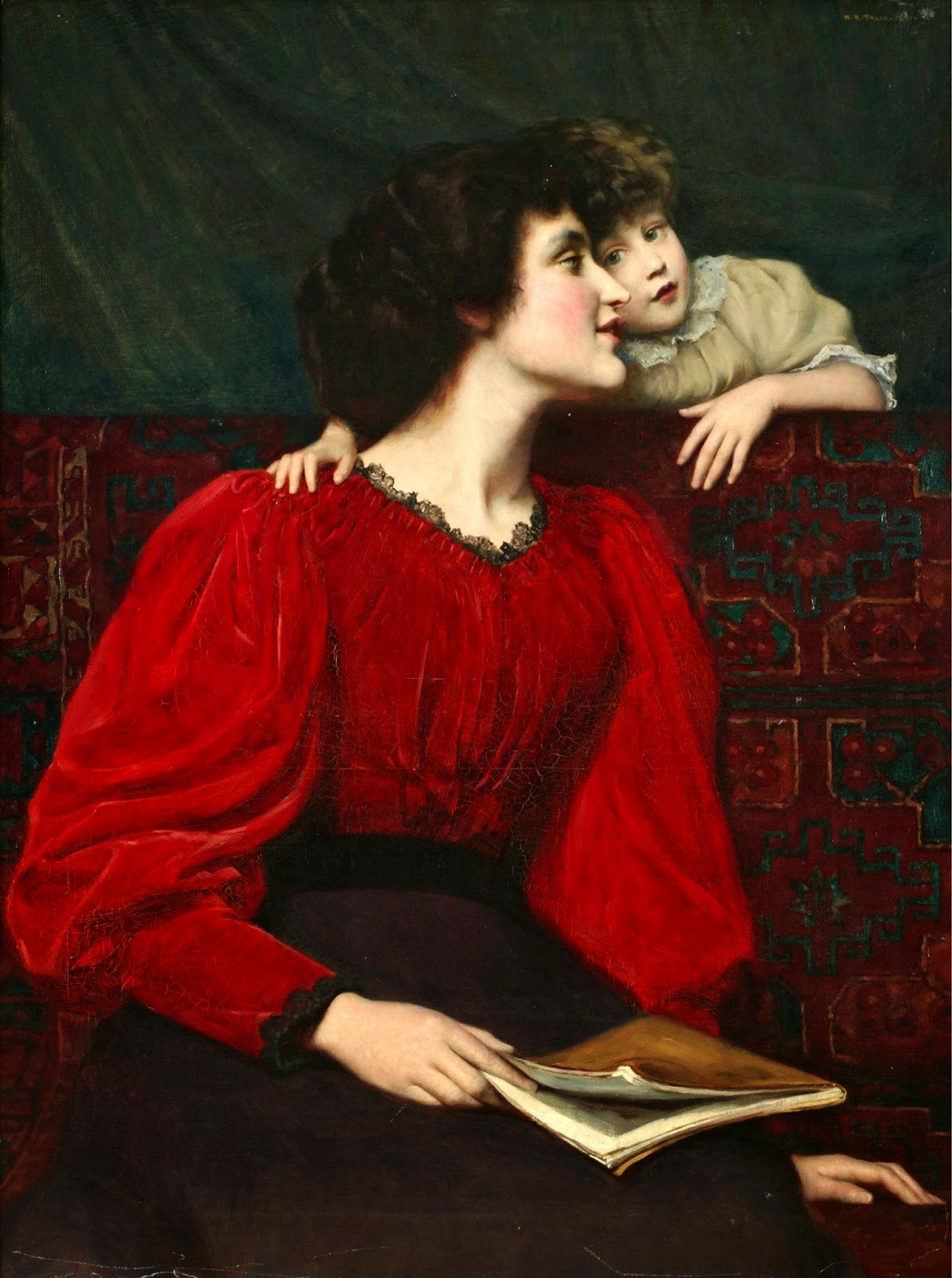
  
 William Mainwaring Palin: Mother and Child (1899)
  
 William Marlow: View on the Thames
  
William Maw Egley: Tracing the Ship's Course (1898)

Sunday, March 23, 2014

Pot-pourri

 Leonard Raven-Hill: The Art Critic (1867)
  
 Lewis Henry Shepheard: Figures sheltering beneath an oak tree in Windsor Great Park
  
 Lowes Cato Dickinson: Gladstone's Cabinet of 1868
  
 Maria Gastineau: Folkestone (1861)
  
Matthew White Ridley: The Pool of London (1862)

Saturday, March 22, 2014

H is for Henry

 Henry Perronet Briggs: Romeo and Juliet, Act II Scene 5 ('Juliet and her Nurse') (1827)
  
 Henry Perronet Briggs: The First Interview between the Spaniards and the Peruvians (1827)
  
 Henry Redmore: Luggers and other commercial traffic in a calm off Whitby (1871)
  
 Henry Thomas Dawson: Dartmouth Castle (1884)
  
 Henry Tonks: Rosamund and the Purple Jar (ca. 1900)
  
 Henry Turner Munns: Turkish Beauty (1892)
  
Henry William Banks Davis: The Approach of Bealloch-na-ba, Applecross

Friday, March 21, 2014

Linnie Watt

Linnie Watt (1875-1908) was best known for her delicate paintings on china. Here is a take on her work from a contemporary: "The last English artist I can mention here is Miss Linnie Watt, whose dainty pictures of English country, enlivened with not less charming English figures of girls or children, remind one (with a difference) of the delicate water-colours of Mrs. Allingham. Much that is characteristic of the tender beauty of woodland and meadow she has learnt how to suggest with a simple expressive touch specially suited to her materials and the decorative character of her work. I would have named her amongst the artists of landscape but for her figures, and amongst the figure-painters but for her landscapes. But it is impossible to divorce one from the other, for the figures are not "introduced," but seem to form an organic part of her conceptions." (Cosmo Monkhouse, "The Royal Academy of China-Painting," The Magazine of Art, 1884, p. 249)

 A Student of Nature (1877)
[either this date is wrong or her birth date is wrong; no matter how talented,
she couldn't have painted this when she was two!]
   
 A Woodland Walk
  
 Children in a Farmyard
[my title; original is unknown]
  
 Dutch Street Scene (ca. 1886)
  
 Painted Faience Plaque (ca. 1890)
  
St Margaret's Bay, Kent

Thursday, March 20, 2014

Pot-pourri

 Nicholas Joseph Crowley: The Caution
  
 Norman Garstin: The Morning Lesson (1882)
  
 Ormsby Wood: The Croquet Game (1876)
[interesting perspective - working-class people 
watching the "quality" playing through the fence]
 
 Penry Williams: Pilgrims Reposing at a Cross (ca. 1835)
  
 Peter Graham: A Highland Croft
  
 Phoebus Levin: The Dancing Platform at Cremorne Gardens (1864)
  
Reginald Arthur: Joseph Interprets Pharaoh’s Dream (1894)

Wednesday, March 19, 2014

Charles Spencelayh

Charles Spencelayh (1865-1958) was a painter of genre scenes and portraits. In later years he focused largely on domestic scenes depicting old men. Although he painted well into the 20th century, his roots were in Victorian times.

 A Winter Traveler (1895)
  
 Always Busy
  
 Behind the Screen
  
 Elevenses
 [what is elevenses?]
 
 Helping Mother (1899)
  
 Kitty Spencelayh (1893)
  
 Perplexed
[I'm perplexed too - what's the story here?]
  
 Rochester Castle (1895)
  
 She Stoops to Conquer
[there's something rather creepy about this one...]
  
 Snodland Ferry, Kent (1893)
  
 That Damned Cat
  
 The Morning Chapter
  
 The Old Dealer (The Old Curiosity Shop)
  
 The Penny Whistle
  
Who Dies if England Live (1914)
[propaganda doesn't get more blatant than this]

Tuesday, March 18, 2014

Louis Haghe

Belgian-born Louis Haghe (1806-1855) was a watercolorist and lithographer.

 Fighting his Battles Over Again (1849)
  
 Prince Albert in costume for the 1745 Fancy Ball
  
 The Ballroom, Buckingham Palace, 17 June 1856
  
 The Fancy Ball at Buckingham Palace, 17 June 1856
  
 The Great Exhibition: Moving Machinery (1851)
  
The Medieval Court of the Great Exhibition of 1851
 
The remaining images were published in Haghe's Portfolio of Sketches Drawn in Belgium and Germany, published in 1850 by Thomas McLean.
 
 Ancient Bourse, Antwerp
  
 Brewers Corporation Room, Antwerp
  
 Chapel of Sainte Gertrude, Nivelles
  
 Sacristy, Church of Notre Dame, Treves
  
 Tomb de Lalaing, Hoogstract
  
Town Hall, Brussels, Belgium